21 Apr 2011

Golden Week


Golden Week
is a large consecutive holiday, which occurs from 29th of April to 5th of May. It includes 4 national holidays:


April 29th
Shōwa Day (昭和の日)
This holiday is a commemoration of the birthday of the
Shōwa Emperor Hirohito, and is celebrated to encourage people to reflect on his 63 year reign (1926-1989).


May 3rd
Constitution Memorial Day (憲法記念日)
A holiday to commemorate the
promulgation of the Japanese constitution, on May 3rd 1947. On this day, the National Diet Building is open to public visitors. People often choose this day to reflect on the meaning of democracy in Japan.


May 4th
Greenery Day (みどりの日)
It was originally celebrated on April 29th, and referred to Emperor Hirohito, drawing on his love for plants and nature, but without mentioning his name. Nowadays, it is thought of as a holiday to connect with nature.


May 5th
Children's Day (こどもの日)
The holiday was originally called Tango no Sekku (端午の節句) and was celebrated on the 5th day of the 5th moon in lunar calendar. It is sometimes referred to as Boy's Day (along with Hinamatsuri as Girl's Day). Families hang carp-shaped flags and display helmets and Kintarō dolls.

Nowadays, because Golden Week is the longest consecutive holiday, it is the most popular travel time. Some companies give their employees time off for the working days in between the holidays, otherwise workers tend to take paid leave off work and travel.
Travel plans include Japan as well as Asia, Americas and Europe.

18 Apr 2011

Hanami


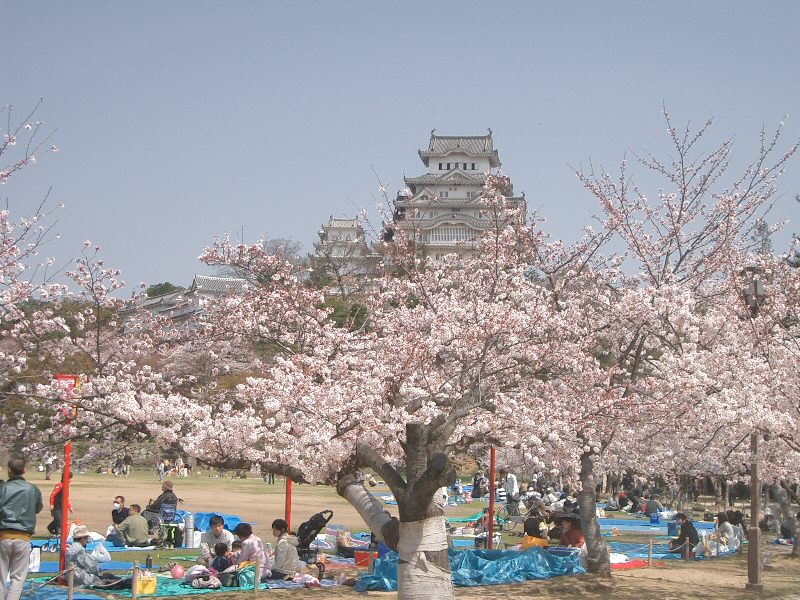
Since it's April all across Japan the cherry trees (sakura) began to bloom. Obviously it doesn't happen all at once, but in waves. It starts from the south and then works up north throughout the whole month.

It is said that the practice of picnicking under the blooming trees started somewhere during the Nara period (710–794), when it was done under the ume trees. Later on in the Heian period (794–1185) the practice became entirely connected with the cherry trees, and has been ever since.

During the hanami, families or work colleagues gather together and have a small party, so to say. The eat bento and drink sake, and generally just enjoy themselves. During the hanami season there are a lot of new products, exclusive to this time of year. These include sweets, meals and alcohol tasting of cherries.

About a week ago I went to Nagoya castle together with my culture class. The view of blooming cherry trees is truly amazing, and it is a pity it doesn't last longer. However, when the petals are blown of by the wind it looks just like snow! And just to make it clear, the cherry trees are not only pink! They vary greatly from absolutely white, through tinted slightly peachy up to actual pink.

2 Mar 2011

Ukiyo-e

Last month, I went to the Nagoya-Boston Museum of Fine Arts to see an exhibition about Ukiyo-e ! I found it very interesting, so I'd like to introduce it to you (^.^)

Ukiyo-e is a Japanese artistic movement from the Edo Period (1603-1868) consisting of prints (engraved on wood).

This kind of print was really appreciated by the Japanese middle classes !

It generally depicts young pretty ladies, courtesans, kabuki actors, sumo wrestlers, famous places, etc.

The ukiyo-e style widely influenced the European impressionist movement.


I am sure you have already seen the work of Hokusai or Hiroshige !

24 Feb 2011

Pandas, Welcome to Japan !

A pair of pandas from China is coming to Ueno Park in Tokyo!

Many Japanese and tourists were waiting for them since the last panda Ling Ling died in 2008.

To welcome the female Xian Lu and the male Bi Li, children and parents are covering the walls near the park with drawings and messages everyday !

For the moment, procedures about the protection and the environment of the pandas are conducted.


From March, it will be possible to see them !! \(^o^)/

18 Feb 2011

Hina-Matsuri (Doll Festival)

On March 3 the Hina-Matsuri (Doll Festival) is held throughout Japan !

Traditionally, each home is decorated with ornamental dolls called ''Hina-Ningyo''.

These dolls represent the imperial court with the Emperor, Empress, but also musicians in dress of the Heian Period (9th-12th centuries).


In general, these dolls are passed down from generation to generation.

Families display ''Hina-Ningyo'' from February to wish girls happiness and take them down on the evening of March 3. If families forget to take the dolls down before March 4 it is thought to bring bad luck for the future marriage of the daughter(s).